
Scope and clinical context
NICE CG98 applies to newborn babies with jaundice from birth through 28 days. It includes recommendations on information for families, visual inspection, bilirubin measurement, treatment thresholds, phototherapy, exchange transfusion, and investigation of underlying disease.
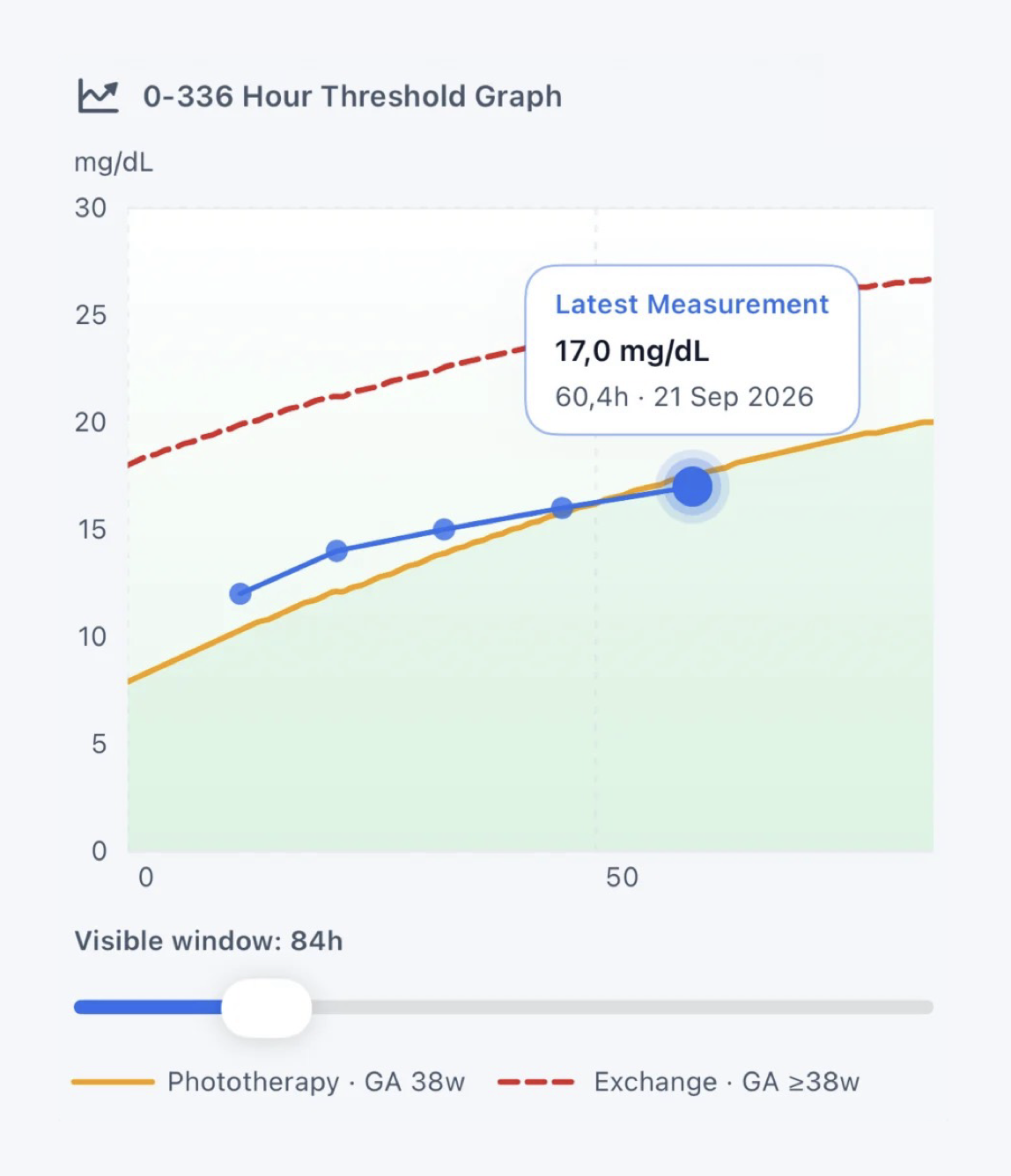
The guidance instructs clinicians to interpret bilirubin levels by the baby’s postnatal age in hours and to use its threshold table and treatment-threshold graphs. Threshold charts take account of bilirubin concentration, gestational age, and postnatal age.
NICE recommends urgent serum bilirubin measurement within 2 hours for babies with suspected or obvious jaundice in the first 24 hours, continued monitoring, and urgent medical review to exclude pathological causes. See the official recommendations for the complete pathway.
How the NICE threshold framework is organized
| Element | NICE CG98 context | Clinical check |
|---|---|---|
| Population | Newborn babies under 28 days; treatment graphs are provided by gestational age. | Select the applicable graph or table for gestational maturity. |
| Horizontal axis | Postnatal age in hours. | Calculate from birth time to measurement time. |
| Vertical axis | Total serum bilirubin, conventionally shown in micromol/L in NICE materials. | Verify and convert units carefully when required. |
| Treatment boundaries | Phototherapy and exchange-transfusion thresholds are separate. | Use the official table or gestation-specific graph. |
| Laboratory context | NICE notes variation between assays from different manufacturers. | Consult the local pathology laboratory when interpreting thresholds. |
Measurement and monitoring
NICE links repeat measurement intervals to age, risk factors, proximity to the phototherapy threshold, and whether phototherapy is in progress. It advises against using phototherapy when bilirubin does not exceed the applicable phototherapy threshold.
During phototherapy, the guideline recommends repeat serum bilirubin measurement 4–6 hours after initiation and then every 6–12 hours once the level is stable or falling. Follow the official wording and local protocol for patient-specific decisions.
Rapid bilirubin rise
NICE identifies a bilirubin rise greater than 8.5 micromol/L per hour as rapidly rising in recommendations concerning intensified phototherapy and increased kernicterus risk. That value belongs to the NICE framework and should be interpreted with its associated recommendations and the full clinical situation.
A numerical rate without its unit, time interval, and guideline context is easy to misread. Document the two measurements, timestamps, calculation, and selected clinical framework.
NeoBili Pro example
View NICE thresholds on iPhone
Select NICE CG98 as a distinct workflow, enter the measurement context, and visualize the result against its phototherapy and exchange thresholds.
View NeoBili Pro on the App StoreOfficial references
- NICE CG98 recommendations: Jaundice in newborn babies under 28 days ↗Includes the threshold table, treatment graphs, and recommendations for measurement and treatment.
- NICE Quality Statement 3: management using treatment thresholds ↗Defines the role of standardized threshold tables and charts.